Getting around during Umrah involves more than one leg of travel, from the airport to your hotel, between prayers at the Haram, and eventually between cities. Understanding your Umrah transportation options in advance turns what can be a confusing set of decisions into a straightforward plan.
Airport to Hotel: Your First Decision
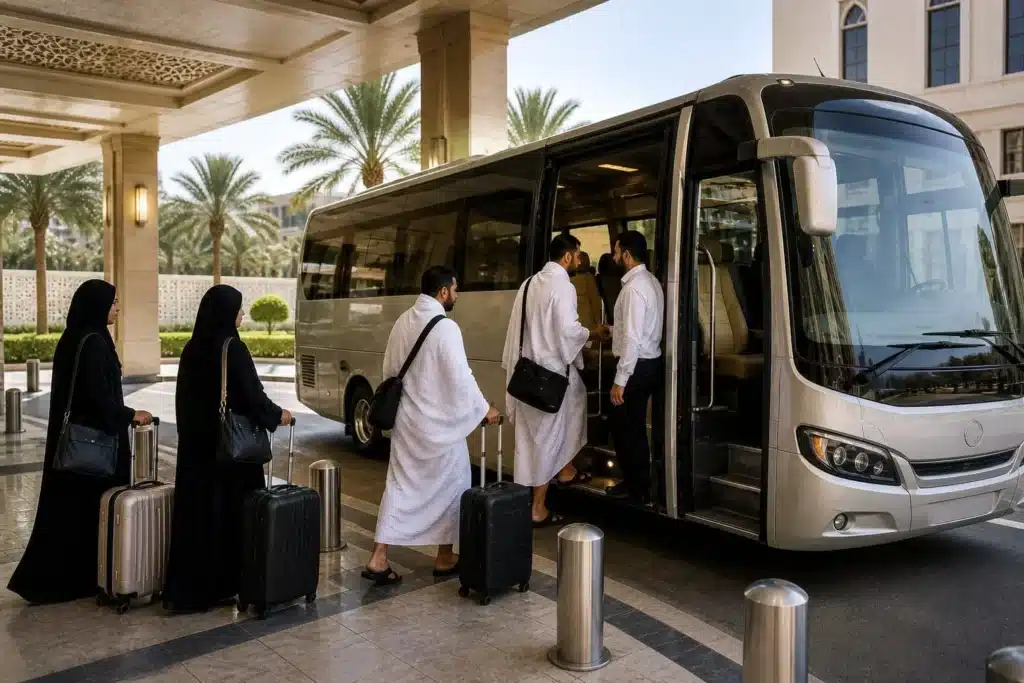
Jeddah’s King Abdulaziz International Airport is the main entry point for most pilgrims, and getting from there to your hotel in Makkah takes roughly an hour and a half by road. Private cars booked ahead of time are the most predictable option, meeting you at arrivals with no haggling or uncertainty after a long flight. Shared buses cost less but add stops and waiting time to an already tiring day. Some pilgrims flying into Madinah’s Prince Mohammad bin Abdulaziz Airport instead skip the Jeddah leg entirely if their itinerary starts there.
Getting Around Within Makkah and Madinah
Once you’re settled, most daily movement is on foot, since hotels near the Haram are chosen specifically for walking distance. For hotels further out, or for trips beyond the immediate mosque area, taxis and ride-hailing apps like Uber and Careem work reliably in both cities. Larger hotels also frequently run their own shuttle service to the Haram for guests staying slightly further away, which is worth confirming when booking a room outside the immediate Central Area.
The Haramain High-Speed Rail
One of the more comfortable ways to move between cities is the Haramain train, connecting Jeddah, Makkah, and Madinah at speeds up to 300 kilometers per hour. It cuts the Makkah to Madinah journey down to roughly two and a half hours, considerably faster than driving, and tickets can be booked online in advance. Stations sit a short taxi ride from the city centers in both Makkah and Madinah, so it’s worth factoring that final leg into your total travel time.
Makkah to Madinah Transport by Road
For pilgrims who prefer driving or need more flexibility than the train allows, Makkah to Madinah transport by road covers roughly 450 kilometers and takes four to five hours. Private cars offer the most comfort for this stretch, with the option to stop along the way, while SAPTCO buses remain the budget option for travelers less concerned about a fixed schedule.
Comparing Your Main Options
- Private car:
Most flexible and comfortable, best for families or anyone with a lot of luggage, at a higher price point. - Haramain train:
Fast and comfortable for the Makkah-Madinah leg specifically, though it doesn’t cover door-to-door transport. - SAPTCO bus:
The most affordable option across all three cities, with less flexibility around timing. - Ride-hailing apps:
Reliable for shorter trips within a city once you’re settled into your hotel.
Booking Ahead Versus Arranging on the Ground
Sorting out transport before you fly is almost always cheaper and considerably less stressful than trying to arrange something at a busy arrivals hall. Prices at airport pickup counters tend to run higher, and availability isn’t guaranteed during the peak Umrah 2027 season. A confirmed booking with a driver’s name and contact details removes that uncertainty entirely.
A Few Things Worth Planning Ahead
Confirming pickup times and vehicle type in writing before you arrive avoids the scramble that catches many first-time pilgrims off guard at a busy airport. It’s also worth checking whether your group’s luggage fits comfortably in whatever vehicle is arranged, since larger families often need a van rather than a standard sedan for longer legs like Makkah to Madinah.
iLinkTours arranges vetted transport across every stage of the journey, from airport pickup to the Makkah to Madinah leg, so getting between the holy cities is planned rather than figured out on arrival.